
There’s a proven way to boost CA students’ reading scores. Why do schools resist it?
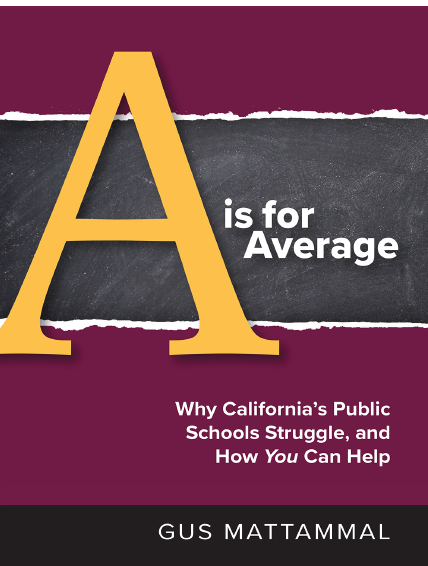
A corrosive teaching fad that made children bad at reading has long since been debunked, says Gus Mattammal in his education policy book A is for Average. But California has been slow to replace it with a proven method that would help the state’s most disadvantaged students. The candidate for Superintendent of Public Instruction argues that cynical and ideological forces are to blame.
California…has done a remarkably poor job teaching children to read over the last twenty-five years. The most recent [National Assessment of Educational Progress] NAEP scores ranked California 38th in 8th grade reading and 37th in 4th grade reading. This raises a critical question: why is California so ineffective at teaching reading?
The answer is, in part, surprisingly simple. California deliberately teaches children to read using methods that cognitive science debunked long ago.
At this point, you are likely wondering why would we do that? Whenever you find yourself asking this question, there is a good chance that the answer is one or both of the following reasons:
1. Politics
2. Money
In California’s case, it is both.
…
1. The old-fashioned method of teaching children to read—teaching them to sound out words and using phonics drills—is, empirically, extremely effective.
2. A woman named Marie Clay developed an alternative approach. Instead of teaching students to decode words, her method encourages them to guess words based on context, pictures, or other clues. This approach spread widely across the United States and much of the developed world.
3. By the late 1990s, cognitive science had thoroughly debunked Clay’s method, showing it to be substantially less effective than the phonics-based approach, which became known as the science of reading.
4. In 2002, President George W. Bush promoted the science of reading through the No Child Left Behind Act. This sparked a political backlash. Many teachers rejected the initiative not because of the science itself but because it was associated with Bush.
5. By the 2000s, consultants and companies had built an entire ecosystem around Clay’s approach. They had a financial interest in maintaining the status quo and resisting the adoption of the science of reading.
Politics is evident in point (4) and money in point (5).
Excerpt from Gus Mattammal’s book A is for Average.
Follow Opportunity Now on Twitter @svopportunity
We prize letters from our thoughtful readers. Typed on a Smith Corona. Written in longhand on fine stationery. Scribbled on a napkin. Hey, even composed on email. Feel free to send your comments to us at opportunitynowsv@gmail.com or (snail mail) 1590 Calaveras Ave., SJ, CA 95126. Remember to be thoughtful and polite. We will post letters on an irregular basis on the main Opp Now site.