☆ Should Silicon Valley even have a public school system?
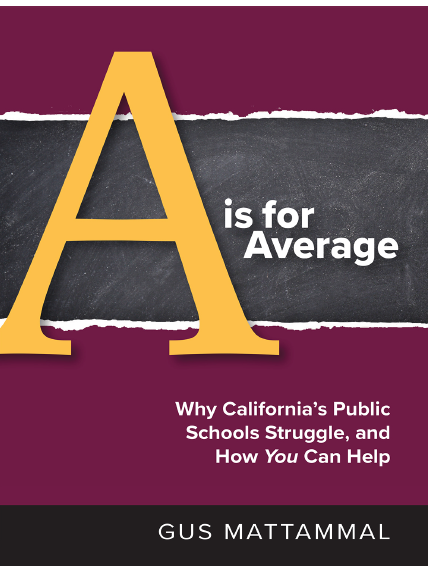
As top-down state policy degrades student achievement in SJUSD, the argument against public schools could be gaining purchase. But Gus Mattammal (candidate for CA Supe of Public Instruction and author of A is for Average) makes the case for reforming, not discarding, public education. While distributed opportunity to children everywhere is key to our economic health, he asks if California’s $130 billion-per-year system is actually delivering results.
Many bring a Libertarian perspective to the discussion, generally citing two basic lines of argument. First, that public schools are an infringement on civil liberty and parental choice, and second, that the existence of public schools puts the government in the position of imposing state-determined narratives on the population, thereby reducing diversity of thought and subjecting education to the whims of the political process.
These are both valid concerns…parental choice and the issue of state-determined narratives. For now, let’s say that both issues are addressable in a high-functioning public school system, and let’s shift our focus to the arguments for such a public school system.
Public education ensures the broadest possible development of a skilled workforce, which in turn makes America more competitive, especially as the world continues to evolve from a manufacturing-based economy to a knowledge-based services economy. As the Brookings Institution notes in its article “Twelve Facts About the Economics of Education,” a person with a professional degree will experience one-fourth the level of unemployment and three times the weekly earnings of someone whose education level is less than a high school diploma.
But if ability is randomly distributed in the population, then it’s imperative that we have a public school system that functions well everywhere, not just in a few lucky places. Partly that’s out of a basic sense of fairness: every child should have access to a quality education. But it’s also partly for the very basic self-interest we all have in ensuring that our school system can identify and develop all our best intellectual talent, which, by virtue of being randomly distributed, could appear anywhere.
So, should we have a public school system? Yes, we should. But it needs to be both well-designed and well-functioning to be worth the enormous investment of resources it takes to have such a system at all. How well-designed and well-functioning is California’s 130-billion-dollar-per-year school system? How good is it at producing smartness everywhere?
Excerpt from Gus Mattammal’s book A is for Average.
Follow Opportunity Now on Twitter @svopportunity
We prize letters from our thoughtful readers. Typed on a Smith Corona. Written in longhand on fine stationery. Scribbled on a napkin. Hey, even composed on email. Feel free to send your comments to us at opportunitynowsv@gmail.com or (snail mail) 1590 Calaveras Ave., SJ, CA 95126. Remember to be thoughtful and polite. We will post letters on an irregular basis on the main Opp Now site.