Failing public schools ruin children’s lives. Why won’t California expand school choice?
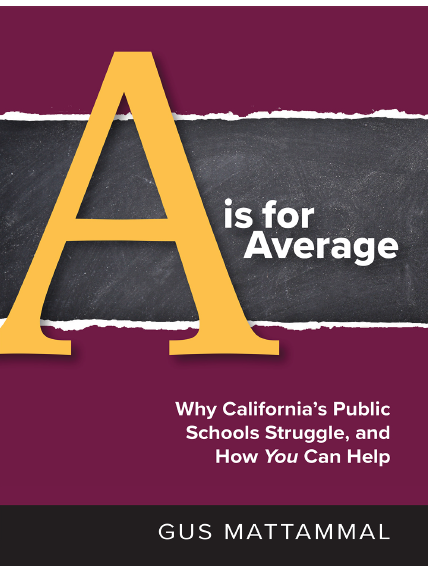
A bad school district is like a jail sentence, sometimes literally, as many students either drop out or get caught up in the juvenile justice system. So says Superintendent of Public Instruction candidate Gus Mattammal, who argues school choice is the way out, and in California that won’t mean “vouchers.” In this excerpt from A is for Average, Mattammal highlights the urgent need for more public charter schools.
If you’ve never lived in such an area, then you likely have no real idea what a failing public school does to a neighborhood. You likely have no real idea what it communicates to the families and children of that neighborhood that they will be sentenced to go to a failing school whether they like it or not. You likely do not understand the message it sends to those families and those children about how much society actually values them, and no number of pretty speeches about “equity” and “equity priority communities” and “our commitment to public education” will ever paper over the gaping hole that a failing public school punches in the heart of a community.
And that brings me to school choice.
The first thing you should understand about school choice is that it can mean a lot of different things, but most people only think of one particular thing when they hear the words “school choice”: vouchers. It’s analogous to universal healthcare: there are actually many different ways to achieve universal healthcare – England’s model (the government owns everything) is different from Switzerland’s (basically Obamacare), which is different from Singapore’s (universal health savings accounts). But mention universal healthcare in the United States, and almost everyone just assumes you’re talking about “Medicare for All,” even though there are many other options.
Similarly, almost everyone immediately thinks of vouchers when they hear the words “school choice,” but there are many different school choice policies. EdChoice has a pretty comprehensive list of options and what they mean. This book is focused on how to solve the two-tiered educational outcomes that California’s existing public school system produces, so we will focus on the four options most likely to move the needle on that: public charter schools, magnet schools, open enrollment, and microschools.
…
The first thing to understand about public charter schools is that they are public schools. I mention this because one of the immediate objections to any discussion of charter schools is that they “just take resources away from public schools.” In a district whose schools are already performing well, that’s an argument that perhaps can be made in good faith. But in a district like the one I grew up in, where Roosevelt High School put up a 25-year record of having a roughly 25% graduation rate, that is not a good faith argument. No family in my neighborhood would ever send their kids to Roosevelt if they had another option. Charter schools provide such an option, while still remaining true to America’s commitment to providing universal public education.
The fact is, there’s a large and growing body of evidence to suggest that public charter schools do increase educational outcomes, and their impact is the biggest on low-income, minority students in urban areas. For California, where so many of the most struggling districts are in cities like Los Angeles, San Francisco, and Oakland, the failure to implement more public charters in struggling districts represents a colossal waste of an opportunity, a waste which falls hardest on primarily low-income, overwhelmingly Black and brown kids. California has the world’s 4th largest economy, and a tech sector that all but prints money, but perhaps the richest thing in all of California is the irony of seeing a state that never misses an opportunity to pat itself on the back for its commitment to “equity” deliberately withhold or slow walk the one thing that has ever proven capable of closing the black-white achievement gap: public charter schools.
Excerpt from Gus Mattammal’s book A is for Average.
Follow Opportunity Now on Twitter @svopportunity
We prize letters from our thoughtful readers. Typed on a Smith Corona. Written in longhand on fine stationery. Scribbled on a napkin. Hey, even composed on email. Feel free to send your comments to us at opportunitynowsv@gmail.com or (snail mail) 1590 Calaveras Ave., SJ, CA 95126. Remember to be thoughtful and polite. We will post letters on an irregular basis on the main Opp Now site.