
☆ Does math “equity” in high school lead to income subtraction for Black students?
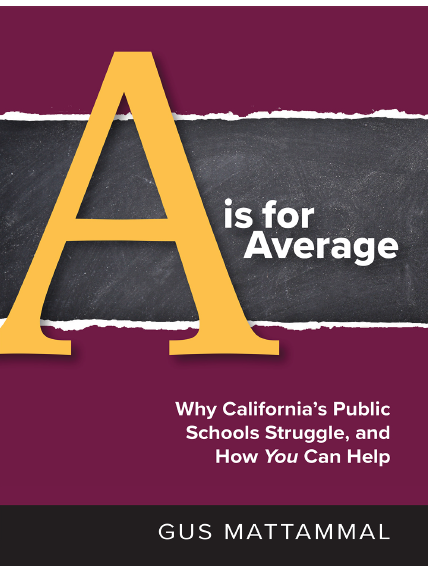
If you want higher income, it’s more important to study math in high school than to graduate high school. That’s from two separate studies, and it’s reason enough to keep standards high, says Gus Mattammal. In his book A is for Average, the candidate for Superintendent of Public Instruction argues against dumbing down math education in the name of “equity” because in doing so, Black students lose out on earnings potential.
While I am not aware of any mainstream movement advocating against the teaching of math entirely, there are plenty of folks who advocate for teaching only those math skills required for basic daily life. Andrew Hacker, author of The Math Myth, argues that we should abandon traditional math classes like Algebra or Calculus and focus instead on numeracy. Numeracy can be understood as the mathematical equivalent of literacy—the ability to conceptualize and apply simple numerical concepts. Here again we see that A is for Average mentality: the suggestion is to dumb everything down to a few simple concepts and then pat ourselves on the back for the bold progress we’ve made.
Of course, it is trivially true that all students should develop numeracy skills. I am also a serious supporter of teaching kids related concepts such as financial literacy. However, not giving kids any exposure to advanced math is misguided at best. The vast majority of students will never need to understand the significance of class uprisings in medieval Europe, differentiate between kingdom, order, and phylum, or analyze archetypes in an Elizabethan-era play. Yet, we still expose children to world history, biology, and Shakespeare. We teach these subjects, not because they are strictly necessary for daily adult life, but because they develop the core skills needed to achieve success: critical thinking, communication, logic, and the ability to learn new things.
Research from the Federal Reserve Bank of Cleveland examined how studying math affects students’ outcomes in the labor market, especially for those who do not go on to college. The findings were striking: for both high school dropouts and graduates, stronger math preparation led to better employment rates and higher earnings. In fact, for high school graduates, the earnings difference between students with strong versus weak math backgrounds was roughly equivalent to the financial return of completing an additional year of college. In other words, students who never set foot on a college campus could still earn substantially more money simply by taking more math in high school, a place where the tuition cost is zero (at a public high school, of course).
A second study, conducted by the National Bureau of Economic Research, looked at how increasing math course requirements affected long-term earnings. The researchers found that when states raised those requirements, Black high school graduates saw their adult earnings increase by 3–4%. The additional math did not make students more likely to attend college, but it did move them into jobs that demanded higher cognitive skills, and those jobs paid more. Notably, this relationship did not appear for other subjects; the effect was specific to math.
I highlight the results for Black students deliberately. Many of the A is for Average policies, including weakening or eliminating math requirements, are promoted in the name of “equity.” Yet the evidence shows the opposite: strengthening math education actually narrows the earnings gap. If equity truly matters, then one should advocate for more math, not less.
Excerpt from Gus Mattammal’s book A is for Average.
Follow Opportunity Now on Twitter @svopportunity
We prize letters from our thoughtful readers. Typed on a Smith Corona. Written in longhand on fine stationery. Scribbled on a napkin. Hey, even composed on email. Feel free to send your comments to us at opportunitynowsv@gmail.com or (snail mail) 1590 Calaveras Ave., SJ, CA 95126. Remember to be thoughtful and polite. We will post letters on an irregular basis on the main Opp Now site.