
But do contract cities undermine democracy?
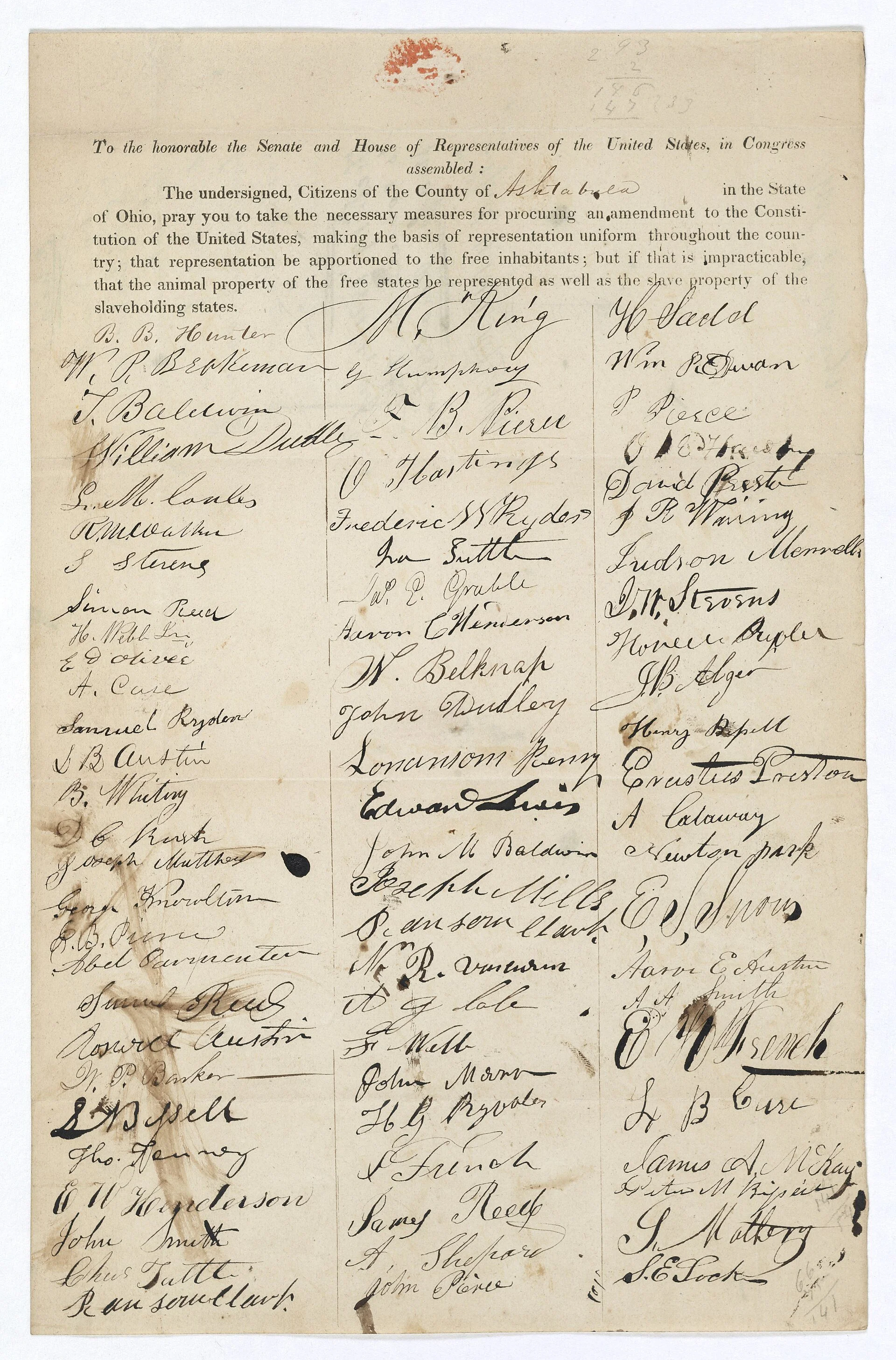
Petition from Citizens of Ashtabula County, Ohio for a Constitutional Amendment that Representation in Congress be Uniform throughout the Country. Center for Legislative Archives, Public domain, via Wikimedia Commons
.jpg)
Outsourcing cities may save money, but do they undermine public transparency and taxpayer control? Is it the realm of the bureaucrat? The Arias Journal explores.
Supporters of contract cities say the model is a fiscally responsible solution, especially for newer or smaller municipalities.
Budget Savings: Avoiding pensions, vehicles, and full-time staff reduces long-term obligations.
Flexibility: Contracts can be renegotiated or replaced. Cities aren’t locked into a permanent department.
Efficiency: Counties already have the infrastructure and workforce in place.
For instance, the City of Eastvale, incorporated in 2010, contracts nearly all of its services and runs with fewer than 25 full-time staff for a population of over 70,000.
“We’re nimble,” one city manager said at a recent public meeting. “We’re not burdened by a bloated government; we’re a city that behaves like a startup.”
The Accountability Tradeoff
But critics say that what contract cities gain in efficiency, they lose in direct oversight. When services are provided by someone else’s agency or a third-party contractor, it becomes harder for the public to influence outcomes.
Police oversight is a prime concern. In cities that contract with sheriff’s departments, residents can’t hold a local police chief accountable, since deputies report to a county sheriff, not the city council.
Emergency responsiveness may vary depending on whether a city is prioritized over others by a county-wide agency.
Transparency and public input often decline. Many contract decisions are made administratively, not in public forums.
In 2022, residents in San Juan Capistrano, a contract city, raised concerns after Orange County Sheriff’s deputies were slow to respond to a neighborhood incident. “Who do I call? The mayor? The county supervisor?” one resident asked. “There’s no direct chain of command.”
The Case of Law Enforcement: A Double-Edged Sword
Sheriff contracts dominate the contract city landscape. More than 40 cities in LA County alone contract with the Los Angeles County Sheriff’s Department (LASD). Yet the LASD has been embroiled in controversies for years deputy gangs, excessive force lawsuits, and corruption allegations.
When Compton or West Hollywood residents complain, it’s unclear who’s truly in charge. The city? The sheriff? The Board of Supervisors?
“If something goes wrong,” says one public policy expert, “you have a three-layered system of plausible deniability.”
Who Really Runs the City?
Many contract cities, by design, rely on city managers and consultants rather than elected officials or large staffs. That means much of the decision-making power lies with administrators rather than the public.
In cities like Jurupa Valley or Wildomar, major service contracts are often negotiated behind closed doors. And while these cities technically have mayors and councils, the actual daily operations are handled by outside agencies.
This leads to a civic paradox: citizens vote for a local government that doesn’t fully govern.
Is This the Future?
As city budgets tighten, especially in post-pandemic recovery years, more communities are exploring the contract model. In wealthy suburbs, it’s a way to keep taxes low. In newly incorporated areas, it’s a way to avoid bureaucracy altogether.
But if local government continues to shrink into a management role rather than a service provider, what becomes of public participation? What happens when the mayor is just an intermediary between the community and a contract?
Conclusion: Cheaper, But Not Always Better
Contract cities raise hard questions about the function of democracy at the local level. They are cheaper, more efficient, and often more politically palatable. But the distance between voters and services grows wider and in some places, dangerously so.
In a time when trust in institutions is already fragile, the rise of contract cities may be both a symptom and a cause of our growing civic disconnect.
The question for Southern California isn’t whether contract cities work.
It’s who they work for.
Read the whole thing here.
Follow Opportunity Now on Twitter @svopportunity
We prize letters from our thoughtful readers. Typed on a Smith Corona. Written in longhand on fine stationery. Scribbled on a napkin. Hey, even composed on email. Feel free to send your comments to us at opportunitynowsv@gmail.com or (snail mail) 1590 Calaveras Ave., SJ, CA 95126. Remember to be thoughtful and polite. We will post letters on an irregular basis on the main Opp Now site.