
☆ They are just trying to scare you
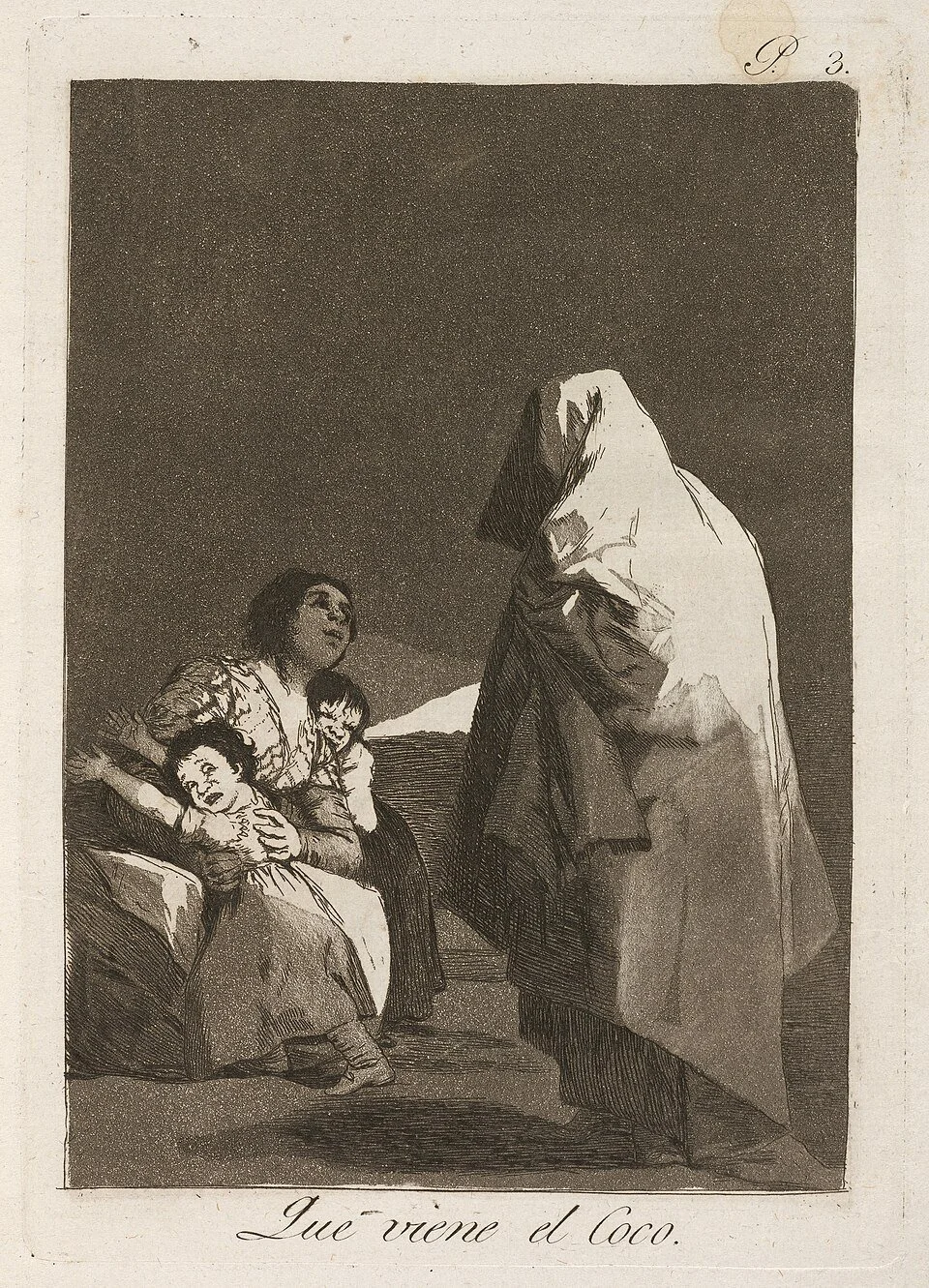
El Cucuy is a mythical ghost-like monster, equivalent to the bogeyman, found in Portugal and Spain. It is a commonly used figure of speech representing an irrational or exaggerated fear. Image "Bogeyman" by Goya. Francisco Goya, Public domain, via Wikimedia Commons
.jpg)
Boo! For local gov't, it seems like every day is Halloween. Yet another chance to scare us all with monsters and ogres who can only be chased away with....more taxes or more density! Our Susie Murillo takes a close look at the costume. An Opp Now exclusive.
I'd like to dedicate today's WR to a deep analysis of the interrelated regulations regarding unit densities and--
Wait, wait, Stop. Everybody come back. That was a joke. I actually want to talk about something a lot more interesting.
El Cucuy. The Boogeyman. The Sack Man.
More specifically, all the ways governments use fake, hypothetical scare tactics to coerce us into supporting unnecessarily extreme (usually tax-raising) schemes that are not in our interests.
Three of the most recent:
The "Housing Element decertification" scare
For those following SJ’s recent upzoning kerfuffle, one alarmist argument being peddled by City Hall is: approve dramatic citywide upzoning or risk violating our Housing Element and unleashing the dreaded “Builder’s Remedy.” But there’s a glaring problem: SJ's Housing Element Program doesn't require the higher densities the city is insisting we study (16+ units). In fact, the state certified San José’s current Housing Element in January 2024 and didn't demand these new densities.The "hospitals will close" scare
County officials hit the alarm button last fall saying that without a major bailout (Measure A) their wildly overextended purchase of hospitals would bust their balance sheets, and the hospitals would have to close--leaving thousands on sidewalks without care. This turned out to be inaccurate, of course, as since then the state bailed out Santa Clara County hospitals, making much of the Measure A (it passed) funding redundant.
Also, national Democrats are campaigning on the promise that if they win back the House (likely) they will restore the funding cuts that prompted Measure A in the first place. How much you wanna bet we won't get our money back?The "transit system will collapse" scare
Proponents of the upcoming Regional Transit Measure (RTM) claim that because local transit systems are in such dire financial shape (having been managed so badly), they will basically implode if they don't get bailed out. And then systems will shut down, no one will be able to get a bus, or train, etc.
This is scaremongering of the highest order, of course, as experts find that all local transit systems could be funded basically at current levels by reallocating ridiculous High Speed Rail costs.
And additionally, that businesslike trimming of the most wasteful elements of the systems (service at barely-frequented stations, wildly overpaid executives, sweetheart union deals, retiree health plans, etc.) could get them on a solid financial footing without dramatic, disruptive cuts.
But of course the pro-tax cabal and their echo chambers in local media would rather scare us with false monsters, camouflage them in bureaucratic blather, and hope we won't notice until after they've squeezed us all yet again.--Susie Murillo
This weekend's readings:
Why are politicians always trying to scare us?
"The whole aim of practical politics is to keep the populous alarmed, and hence clamorous to be lead to safety, because that puts them in a position to be exploited more effectively by the politicians and their supporters, which is what politics is for, after all."--Independent Institute
Why fear is such a powerful motivator in politics
"Fear can sway opinions, but knowing the deliberate and strategic ways in which our fears are exploited can help lessen its effects.
"For example, fear can be used to drive votes toward a particular candidate or party—a method that relies on our natural instinct to find safety in numbers. And, a meta-analysis found that messages with fear are nearly twice as effective as messages without fear."--American Psychological Ass'n
How fear-based campaigning works
"We're hard-wired to give priority to information about threat. We will always prioritize negative information. So we will notice it first, we will remember it longer, and it will be more influential in our subsequent decision-making than will other information."--Don Gardner on PBS
Follow Opportunity Now on Twitter @svopportunity
We prize letters from our thoughtful readers. Typed on a Smith Corona. Written in longhand on fine stationery. Scribbled on a napkin. Hey, even composed on email. Feel free to send your comments to us at opportunitynowsv@gmail.com or (snail mail) 1590 Calaveras Ave., SJ, CA 95126. Remember to be thoughtful and polite. We will post letters on an irregular basis on the main Opp Now site.