
☆ SJ Merc pushes a “14-year” sales tax to save transit. Expert says that’s “misleading.”
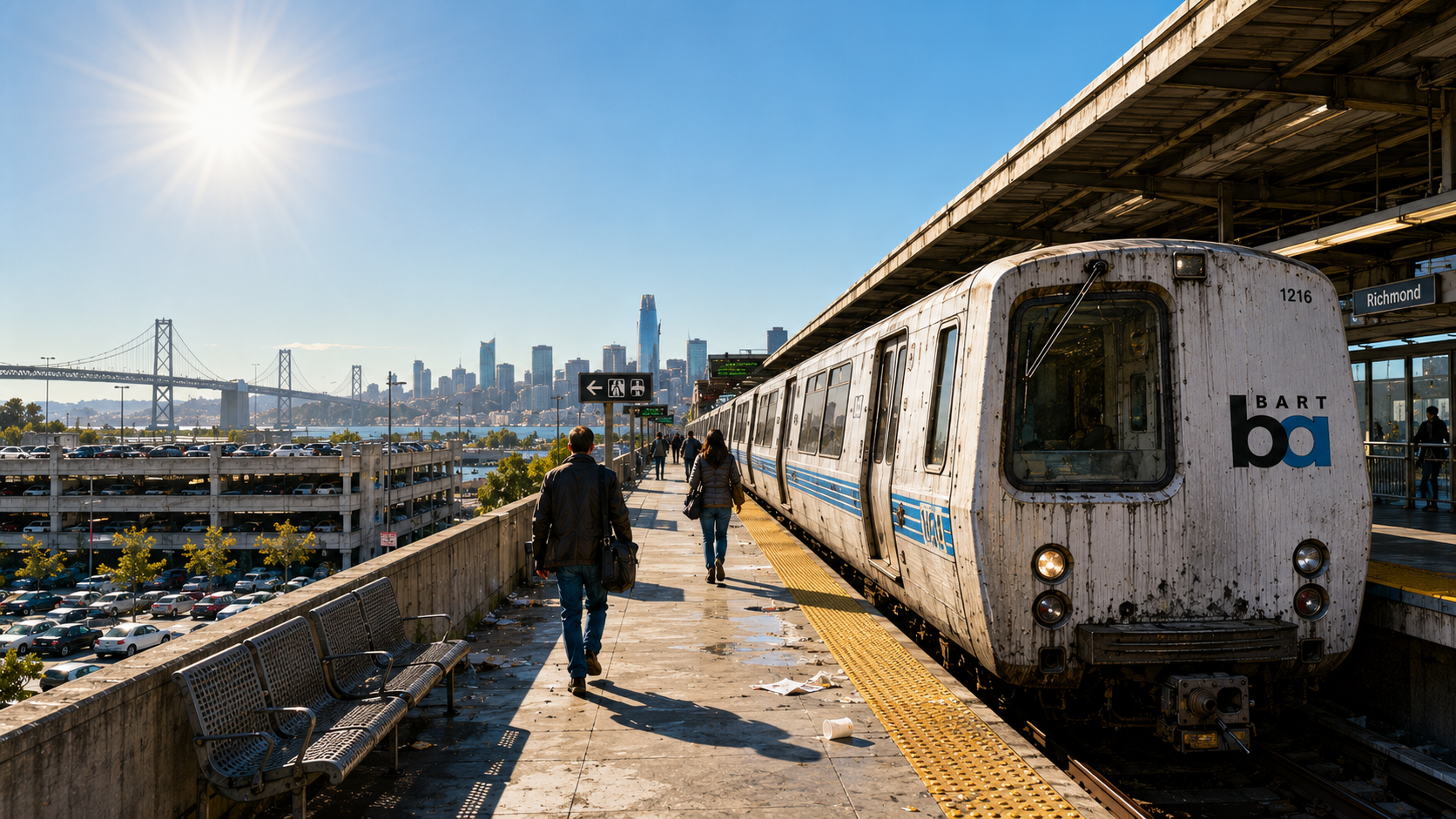
A recent Mercury News article threatens the “sky is falling” if taxpayers don’t bail out transit, says Tom Rubin, who argues that ridership collapsed years ago. Where the Merc doesn’t look for cost savings, the former transit executive does: automate the trains like they did in Vancouver, hire way more part-time operators. Don’t like traffic? Encourage remote work because data show workers are driving, not riding, back to the office. An Opportunity Now exclusive rebuttal to the Merc.
The Mercury News: If the proposed measure fails, BART is considering widespread cuts in 2027 that would include laying off 1,200 employees, closing 10 to 15 stations, raising fares and parking fees by up to 50%, cutting train lines and reducing train hours.
Tom Rubin:
Why didn’t the transit industry start trying to cut costs years ago? Why did they wait until the last moment so they could do this ‘sky is falling’ presentation once again?
Merc: “If they close BART, it’s an attack on the lower class,” said the 42-year-old [Shakira Moore], who uses a wheelchair and relies on buses and trains to get most places.
TR: Longer distance transit is highly utilized by the top quintile, the top 20%. Caltrain, BART, and ferry service are used by upper income people disproportionately. The cuts affect everybody, but oddly enough, it’s the highest income individuals that are most impacted.
Opportunity Now: So a sales tax would disproportionately benefit the top 20%? Meanwhile, don’t sales taxes do most harm to the poor?
TR: Yes, sales taxes are generally considered to be regressive, so that lower income people pay a higher portion of their income to sales taxes than higher income individuals.
Merc: Other public transit riders who take BART, Caltrain, MUNI and other services to get around the Bay Area are depending on a 14-year tax measure that transit officials are banking on to save the region’s trains and buses from deep service cuts and station closures.
TR: I think it is very misleading to say this is a 14-year tax because at the end of 14 years, the need is not going to go away. It is still going to be there.
Merc: BART has cited declining ridership due to the rise in remote work following the COVID-19 pandemic as fueling its financial crisis. Fares and parking fees collected pre-pandemic had covered about 70% of the funding for train operations, compared to now, according to data from BART, with fares covering just over 30% of operating costs.
TB: I agree with the numbers. Pre-COVID, BART and Caltrain had two of the highest farebox recovery ratios in the United States, largely because they were carrying higher income individuals willing to pay a premium. But these people were the ones that remote work worked for the best. Also driving in the Bay Area has recovered and even exceeded its pre-COVID levels, but transit is still way behind.
Merc: The transit agency also reports spending has outpaced revenues while, at the same time, BART is running more trains than it was before the pandemic.
TR: BART is currently in the middle of a program to spend well over a billion dollars for a new automatic train control system to handle higher capacity. But their ridership is down.
Merc: The agency on Jan. 1 raised fares by 6.2%, or about an average of 30 cents from $4.88 to $5.18, to help cover these losses in funding, though that is not enough to save the agency from the major deficit it still suffers, transit officials say.
ON: Revenue from taxes, revenue from fares. The Merc only talks about revenue. Aren’t there ways transit could look to stop spending so much money?
TR: The big expense is labor. Salary, wages, employee benefits and work rules. To the best of my knowledge, they’ve never even asked the question of unions about making less money or loosening work rules.
You can hire part-time operators for a lot less. Also, autonomous train control systems have been around for a long time. Vancouver has had autonomous train controls since 1986. But BART refuses to even consider spending a little bit of money to be able to take its current system to autonomous and cut the cost of hundreds of train operators.
The reason is the BART unions have a huge amount of power.
Merc: On Thursday, in an effort to help stabilize the region’s transit services, Gov. Gavin Newsom announced a $590 million state loan to BART, AC Transit, Caltrain and San Francisco MUNI, which will help the agencies cover operating costs until they can collect new tax money, assuming the measure passes. The transit agencies would have 12 years to repay it.
ON: And if the measure doesn’t pass?
TR: The debt needs to be guaranteed. The main backup guarantee is the funding for BART to San Jose. If BART to San Jose just never gets approved, then the funding the state had put aside for a capital project could be utilized. Or the state could forgive the loan. But it’s kind of hard to throw a lot of money at a region that is a little under 20% of the state population without throwing a more or less similar pot of money at the rest of the state
Merc: Orinda Councilmember Darlene Gee told this news organization her city’s BART station is a cornerstone of Orinda’s downtown. She said a tax measure won’t solve all transportation funding issues in the region, but it will help give transit agencies time to do “some serious rethinking” about the long-term structures of these systems.
TR: This has been obvious to anyone for well over a decade, even pre-COVID. Transit was having less and less of an impact, fewer and fewer people were riding it, and the transit agencies refused to take any steps to reduce costs and provide greater productivity.
If we bail them out again, why would anybody believe them when they say now they have to really, really seriously start thinking about what we can do better and at less cost. It's just not realistic.
Merc: Gee’s biggest fear, she said, is the possibility that voters will make a decision based on old experiences and assumptions about BART — that the system is unsafe and dirty.
TR: Why shouldn't voters consider the number of times that BART has unexpectedly, with no notice, totally shut down large parts of the system. People are leaving BART and other transit systems because they feel unsafe and because it's dirty. And why should they think if they give BART more money, that something will change? This bailout money doesn’t do anything it only replaces previous bailout monies with a new type of bailout money.
Merc: Carter Lavin, co-founder of transit advocacy organization Transbay Coalition, told this news organization that his biggest concern with a possible failure of the proposed ballot measure is “the Bay Area economy shuts down, the Bay Area becomes an inaccessible place to millions of people and traffic becomes even more unbearable.”
TR: People say transit needs more money, but transit has been failing for decades. In 2016 the total bay area transit trips was almost exactly the same, down to less than a million of the more than half a billion riders in 1980. During that time, the population of the Bay Area had climbed by about 50%. So, transit has been becoming less and less important, even as the spending has gone up two and a half times, inflation adjusted.
Merc: “This is happening because, as a region, as a state, as a nation, we don’t invest in transit. We haven’t done it in any significant amount,” Lavin said. “We have a great opportunity to fix that.”
TR: We have been investing. I did the numbers from 1980 to 2024 in the Bay Area. We had spent over $200 billion over that period. That's a lot of money. Nationally, similarly large investments, every year.
Plus, something in excess of 20% of the Highway Trust Fund is spent on transit. Car and truck drivers put a lot of money into the Highway Trust Fund. Transit doesn't. Also, a lot of what you pay in gas taxes goes to transit.
Follow Opportunity Now on Twitter @svopportunity
We prize letters from our thoughtful readers. Typed on a Smith Corona. Written in longhand on fine stationery. Scribbled on a napkin. Hey, even composed on email. Feel free to send your comments to us at opportunitynowsv@gmail.com or (snail mail) 1590 Calaveras Ave., SJ, CA 95126. Remember to be thoughtful and polite. We will post letters on an irregular basis on the main Opp Now site.