
☆ Silicon Valley has a “staggeringly unequal” school system. Can “Grading for Equity” solve it?
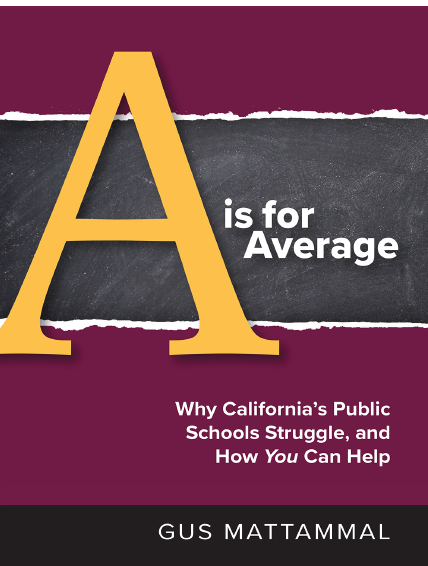
California’s schools promise every student a quality education, yet that’s belied by dismal disparities between districts and racial groups. So says Gus Mattammal, author of A is for Average, who argues policies like “Grading for Equity” only mask the failure while cutting advanced programs.
In the Palo Alto Unified School District, where about 14% of students are Latino or Black, 88% of high school students are proficient in reading and 83% are proficient in math. Families in Palo Alto routinely send their kids to me and my team to prepare them for the project of applying to schools like Harvard, Stanford, and Berkeley.
Meanwhile, in the Cabrillo Unified School District, which includes my home town of El Granada, only 41% of high school students are proficient in reading and only 27% of students are proficient in math. In Cabrillo, where around half the kids are Latino or Black, often children of farmworkers, fishermen, or construction workers, the project is to get the kids into college at all, or, failing that, into a good vocation. It is a completely different educational experience from what the kids in Palo Alto get.
Moreover, this disparity is not only evident when comparing between districts like Palo Alto and Cabrillo; it also exists within districts. For example, even in wealthy Palo Alto, where 70% of high school students receive As (i.e., where the average grade is effectively an A) fewer than half of Latino students meet standards for reading.
Many people recognize how staggeringly unequal the system has become; that’s why initiatives like Grading for Equity were created. Every time we measure the school system, whether through a traditional grading system, through standardized testing, or through observing which kids take more advanced classes, we see that the system is failing in its fundamental purpose of providing every child with a quality education. Fixing that failure is a hard problem to solve—a really hard problem to solve—so rather than deal with the long, hard, frustrating work of really trying to solve the problem, we settle for masking the problem with policies like “Grading for Equity.”
I titled this book A Is for Average not to signify a particular policy, but rather to signify a particular mentality. When traditional grading reveals a systemic failure, abolish traditional grading and implement Grading for Equity instead. When standardized test scores show systemic differences, get rid of standardized tests altogether, as the University of California did. When there are disparities in who qualifies for advanced classes, simply eliminate the advanced classes. Stop offering Algebra I to middle school students, as San Francisco Unified did, or get rid of Honors Biology, as Palo Alto Unified did earlier this year. Problem solved. After all, if we lower the bar enough, the problem disappears.
Excerpt from Gus Mattammal’s book A is for Average.
Follow Opportunity Now on Twitter @svopportunity
We prize letters from our thoughtful readers. Typed on a Smith Corona. Written in longhand on fine stationery. Scribbled on a napkin. Hey, even composed on email. Feel free to send your comments to us at opportunitynowsv@gmail.com or (snail mail) 1590 Calaveras Ave., SJ, CA 95126. Remember to be thoughtful and polite. We will post letters on an irregular basis on the main Opp Now site.