
☆ Our region's driverless future--and its enemies
,_California_Street,_autonomes_Fahrzeug_(Waymo)_--_2022_--_2925.jpg)
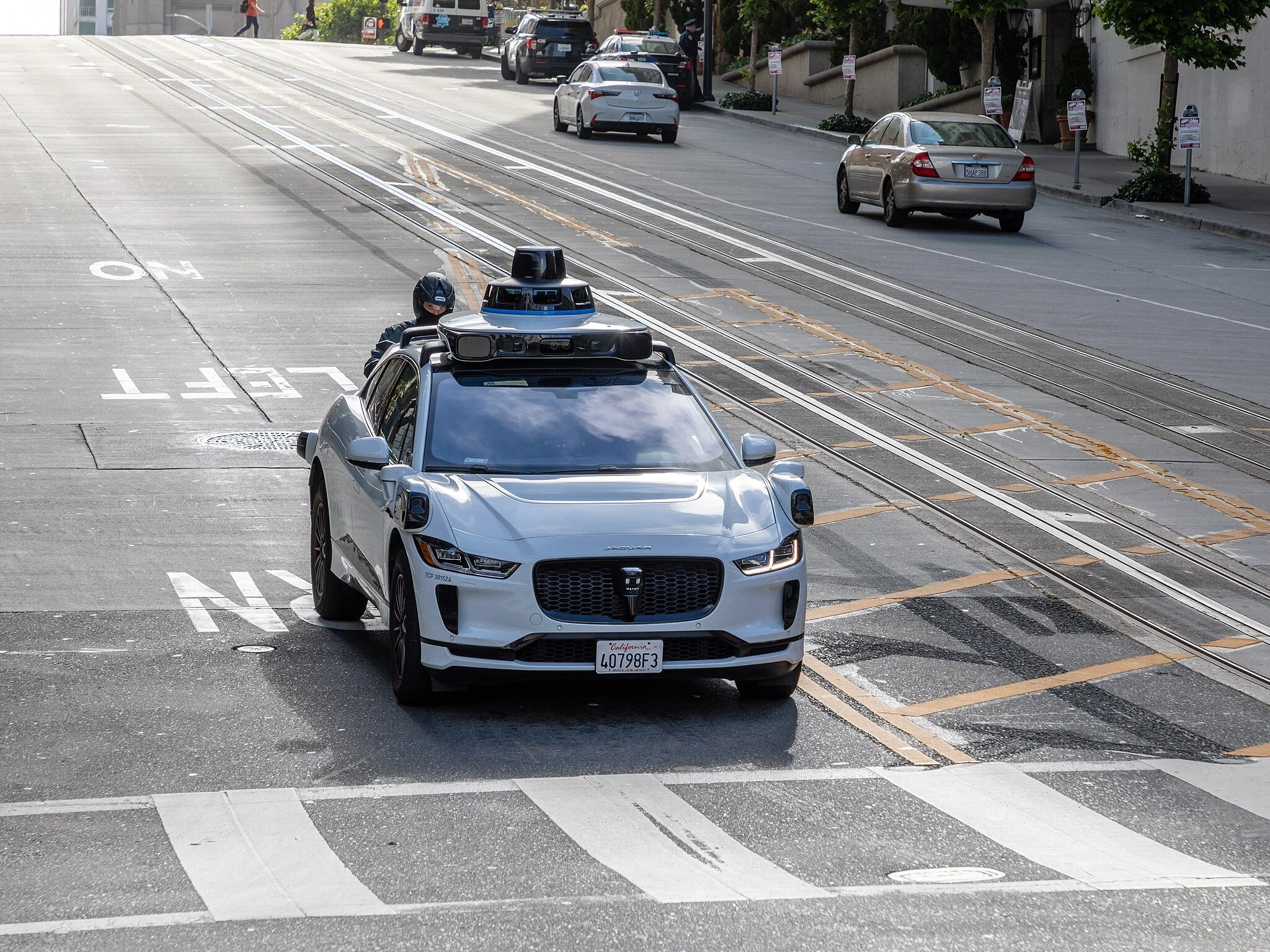
Driverless vehicles are now transforming mobility in the Bay Area. While this technology promises to make getting around both cheaper and more convenient, local political and transit leaders are not adequately incorporating autonomous vehicles into their thinking and instead perpetuating the high-cost model of transportation through the 2030s. Marc Joffe explains in this Opp Now exclusive.
It could be worse. Boston is seriously considering a ban on robotaxis—shocking for a region full of highly educated professionals and accomplished scientists. But it could also be better. Washington, DC whose metro system is a peer to BART (along with MARTA in Atlanta, they are 1970s-vintage systems), is aggressively pursuing automated subway technology.
Instead, the Bay Area is a middling performer in adoption of driverless transportation. The state government has pre-empted local regulation of robotaxis, thereby insulating them from more extreme anti-progress municipal officials.
For example, San Francisco Jackie Fielder can decry the unfortunate case of a Waymo running over a stray cat in the Mission District, but lacks the authority to stop, let alone reverse Waymo’s expansion in the Bay Area.
And, if things go according to plan, Waymo will face competition in San Francisco from both Amazon-backed Zoox and an alliance of Uber, Lucid, and Nuro. Waymo, meanwhile, is expanding its footprint into the Peninsula and San Jose.
But as Tesla has shown, things do not always go according to plan. Tesla is also providing “driverless” taxi service in the Bay Area and Austin but continues to rely on “safety drivers”, sharply limiting the number of robotaxis it can deploy in each market. Elon Musk appears to have made the mistake of excluding LiDAR from Tesla’s self-driving package, and this is limiting the ability of Tesla’s “full self-driving mode” to safely execute the full range of driving tasks without human intervention.
Nonetheless, Tesla’s work is significant. By making a quasi-driverless technology package available to a wide range of new and existing vehicles, it raises many exciting possibilities. Among these are the potential for individually owned vehicles to double as robotaxis when not needed by their owners, and the opportunity for seniors to retain the independence provided by a personal vehicle even if their ability to drive deteriorates. Hopefully, Musk will abandon his opposition to LiDAR now that its cost has fallen, or Tesla will finally figure out a sufficiently safe workaround.
And safety will continue to be the key for driverless vehicle adoption. In the past we have seen both Uber and GM’s Cruise driverless efforts falter after their vehicles killed pedestrians. While there is solid evidence that driverless vehicles are much safer than those driven by us humans—given our relatively slow reflexes, emotional outbursts and propensity for distraction—the public will understandably demand that autonomous vehicles meet a gold standard for safety.
Today’s robotaxis can transport no more than four passengers. But other cities around the world are testing driverless vans and buses. As these become fully reliable in the late 2020s, they can replace operator-driven buses, offering both lower costs and higher frequency.
Driverless trains can provide the same benefits starting with systems like BART that are fully grade separated, But ultimately driverless technologies will be able to operate trains that go through grade crossings like Caltrain or must mingle with cars, like VTA light rail and SF Muni Metro.
Unfortunately, transit agencies now advocating the SB 63 transit tax for next November do not seem to be taking any of this into account. Instead, they will be asking voters for a bailout so that they can maintain their high cost, labor intensive mode of operation.
Marc Joffe is the President of the Contra Costa Taxpayers Association and a Visiting Fellow at the California Policy Center.
Follow Opportunity Now on Twitter @svopportunity
We prize letters from our thoughtful readers. Typed on a Smith Corona. Written in longhand on fine stationery. Scribbled on a napkin. Hey, even composed on email. Feel free to send your comments to us at opportunitynowsv@gmail.com or (snail mail) 1590 Calaveras Ave., SJ, CA 95126. Remember to be thoughtful and polite. We will post letters on an irregular basis on the main Opp Now site.