
The birth of progressive hubris
.jpg)
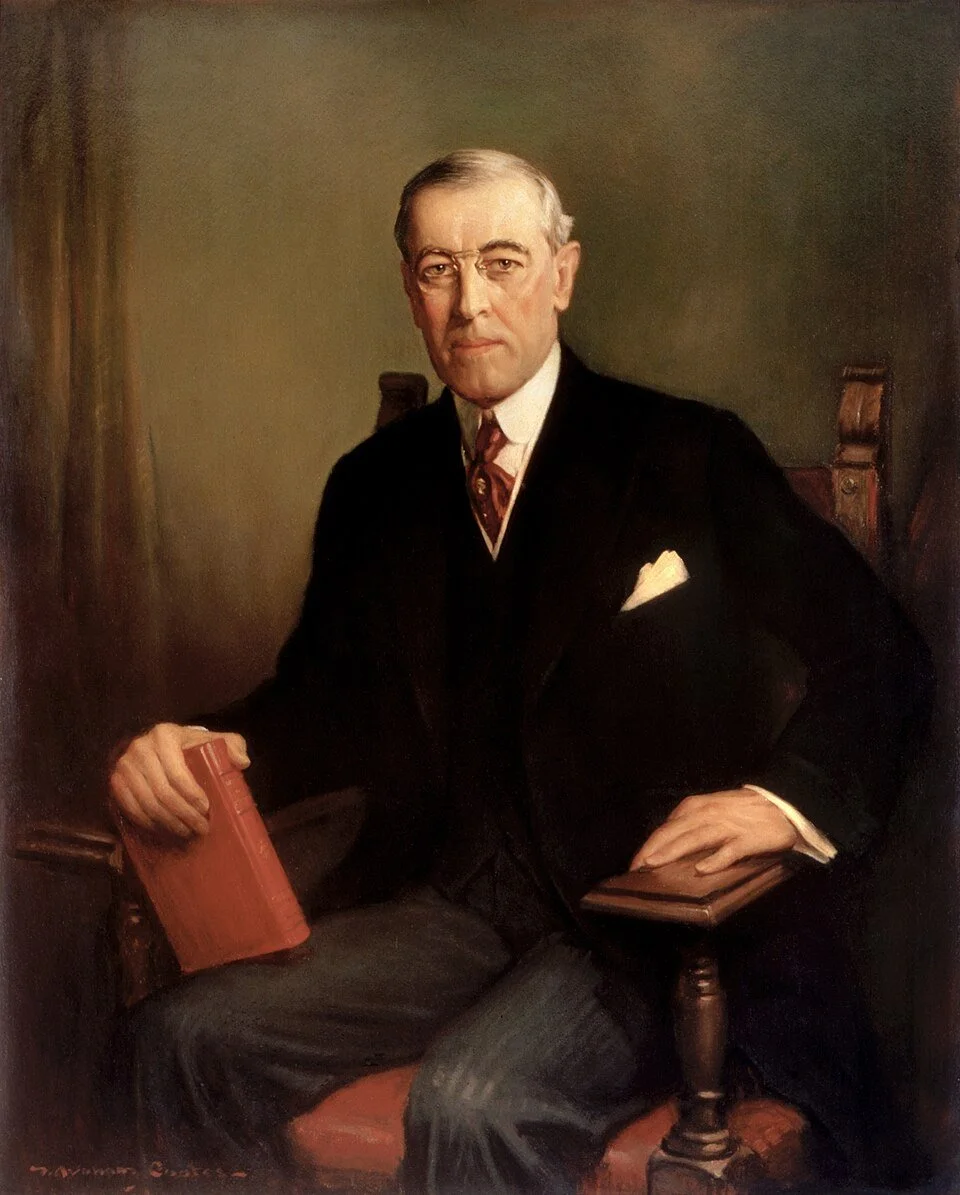
Racism. Suppression of free speech. Bloody foreign misadventures. Welcome to our first progressive’s (Woodrow Wilson's), presidential tenure. From Libertarianism.
Born in 1856, Wilson grew up in the South and was probably the most- virulent racist to sit in the Oval Office since before the Civil War. He served as president of Princeton University, from which he jumped to New Jersey’s statehouse, enlisted by the party bosses to break the GOP’s political stranglehold. Once elected governor, however, he turned against the Democratic establishment and pushed a reformist agenda.
Trenton proved too small to contain his ambitions, especially after the GOP staged a legislative revival. At the 1912 National Democratic Convention, Wilson wooed the progressive forces of William Jennings Bryan and won the nomination on the 46th ballot. However, that otherwise inauspicious start to the campaign was minor compared to the Republican Party split between establishment regular William Howard Taft and monomaniacal egotist Theodore Roosevelt, which gave Wilson the presidency.
Despite the latter’s professorial mien and rhetorical disguise, he unabashedly sought power. Indeed, Wilson “loved, craved, and in a sense glorified power.”7 Certain of his superiority over common folk, Wilson was a progressive’s progressive, frustrated by the Constitution’s constraints on government and presidential powers, which limited his ability to forcibly remake America and its people. He sought to remedy what he saw as a flawed political system, signing into law the imposition of the income tax after the ratification of the 16th Amendment and the creation of the Federal Reserve System, two steps that greatly strengthened federal power.
His dispassionate pose rested upon a deep foundation of sanctimony. He was, said H.L. Mencken, waiting for “the first vacancy in the Trinity.” France’s Georges Clemenceau said of Wilson’s famous Fourteen Points: “God Almighty has only ten!”8 Wilson undoubtedly believed that he was fated to be the world’s representative of humanity.
Unfortunately, his behavior suggested someone who hated people even while professing to love mankind. For instance, Wilson’s soaring vision was primarily for a white nation. Although his reform platform initially garnered support from leading African Americans, his policies were racist and reactionary. When he arrived in Washington, D.C., the federal government was the District’s most significant integrated institution. Not so when he left. Sadly, his “failure to address Jim Crow disenfranchisement, his decision to screen Birth of a Nation at the White House in 1915, his dismissal of African American activists, and—most notably—his administration’s active segregation of the federal government, together helped to further cement the systemic racial injustices that defined American life in the 20th century.”9 (For these actions alone Wilson’s name, no less than those of Confederate officials, should be stripped from buildings, bridges, and other facilities.10)
Wilson’s domestic record was deficient in other ways. He paid little attention to the Spanish Flu epidemic, which cost some 675,000 Americans their lives, almost six times the country’s deaths in World War I. This was a strange response, observed Eric Felten: “One would expect a skilled advocate of federal authority to have used every power of his office to confront a scourge that was killing Americans by the hundreds of thousands.”11 In contrast, Wilson did support mandatory sterilization.12
Perhaps Wilson’s most grievous crime was his assault on fundamental American liberties. As America’s war- time leader Wilson asserted the transcendent rights of man while playing petty dictator. He demanded from Congress the power to suppress dissent. There was no greater crime in his mind than to criticize him and his policies.
In December 1915 while America was still at peace Wilson told Congress: “I am sorry to say that the gravest threats against our national peace and safety have been uttered within our own borders. There are citizens of the United States, I blush to admit, born under other flags but welcomed under our generous naturalization laws to the full freedom and opportunity of America, who have poured the poison of disloyalty into the very arteries of our national life; who have sought to bring the authority and good name of our Government into contempt, to destroy our industries wherever they thought it effective for their vindictive purposes to strike at them, and to debase our politics to the uses of foreign intrigue.”
Thus, he added, “I urge you to enact such laws at the earliest possible moment and feel that in doing so I am urging you to do nothing less than save the honor and self- respect of the nation. Such creatures of passion, disloyalty, and anarchy must be crushed out. They are not many, but they are infinitely malignant, and the hand of our power should close over them at once.”13
It soon did. He continued to push Congress to pass repressive new legislation and even penalize criticism of the president, harkening back to the discredited repression of the Democratic- Republicans during the John Adams administration. Congress responded with the Espionage Act of 1917. Although legislators rejected some of Wilson’s proposals, such as formal press censorship, they punished dissent. Expressions of opposition to or even dissatisfaction with the war led to prosecutions and prison terms under the supposedly great liberal crusader.
In fact, Wilson acted like a typical European tyrant with his administration’s prosecution of Eugene Debs, the socialist leader who ran for president and denounced the conflict as the capitalists’ war. Even after the conflict ended the cruelly vindictive Wilson refused to release Debs, leaving that task to Wilson’s Republican successor, Warren Harding. The contrast between Wilson’s rhetoric and conduct was stunning. Wrote Melvin Urofsky and Paul Finkelman: “the war to make the world safe for democracy triggered the worst invasion of civil liberties” in America’s history, undermining its democracy.15
Woodrow Wilson typically wins a “near great” rating from historians, but for what? As president he was a racist who rolled back civil rights protections and eviscerated civil liberties. His aggressively imperialistic foreign policy brutalized America’s neighbors. His foolish determination to make Washington the deciding power in Europe’s terrible and unnecessary killfest cost thousands of American lives and ultimately made possible the far more devastating World War II.
Judged by impact, his record is one of America’s worst presidents, if not the worst. And his impact persists. Historian Thomas J. Knock cited “the enduring relevance” of Wilson’s vision, in which “he remains unique among presidents of the American Century.”36 Unfortunately. As we have tragically seen with the continuing dissolution of the post- World War I boundaries drawn by the victors, truly the “triumph of Wilson and the war party struck the American Republic a blow from which it has never recovered.”
Read the whole thing here.
Follow Opportunity Now on Twitter @svopportunity
We prize letters from our thoughtful readers. Typed on a Smith Corona. Written in longhand on fine stationery. Scribbled on a napkin. Hey, even composed on email. Feel free to send your comments to us at opportunitynowsv@gmail.com or (snail mail) 1590 Calaveras Ave., SJ, CA 95126. Remember to be thoughtful and polite. We will post letters on an irregular basis on the main Opp Now site.