
It's why they call it "Kafka-esque"
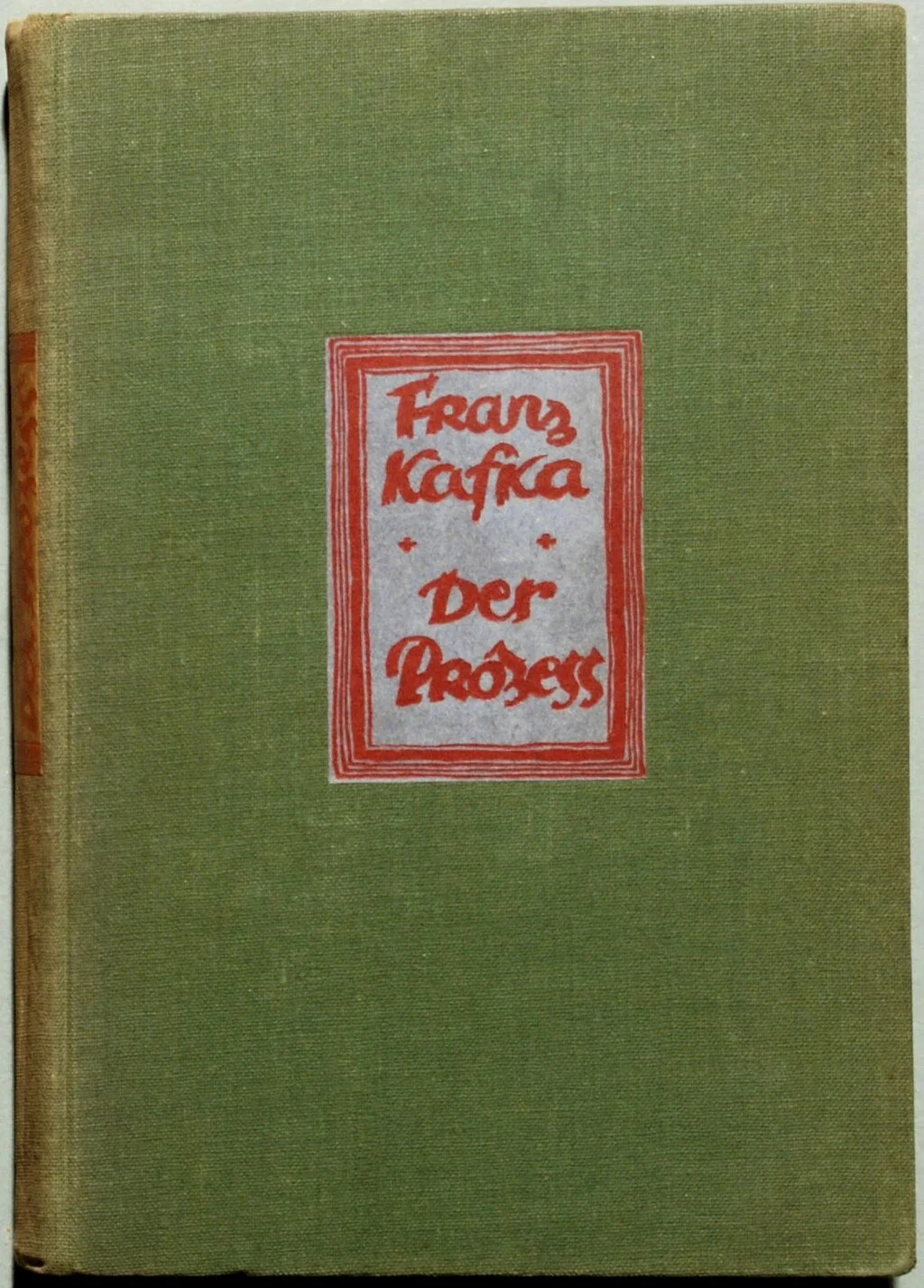
Early German edition of Franz Kafka's The Trial, 1925 © Foto H.-P.Haack, Public domain, via Wikimedia Commons

Like Orwell and Huxley, author Franz Kafka predicted in fiction the rise of the rigid, absurdist, all-powerful bureaucratic state in 1925's The Trial. Interesting Literature explores novel's critique of the Borg-like state.
In a sense, the English title by which Kafka’s novel is known, The Trial, conveys something of the double meaning of the original German title, Der Process: Josef K. is on trial for some unspecified crime, but Kafka’s novel exposes the absurd ways in which all life is a continual trial, ‘trying’ us by testing and challenging us, tempting us to commit things we shouldn’t and making us feel guilty even when we’re not sure precisely what we have done to feel such guilAll of this is tragic and hopeless, anticipating the dystopian futures of people like George Orwell but also the absurdist and existentialist writing of someone like Albert Camus.
For Camus, Sisyphus is the poster-boy for Absurdism, because he values life over death and wishes to enjoy his existence as much as possible, but is instead thwarted in his aims by being condemned to carry out a repetitive and pointless task.
Such is the life of modern man: condemned to perform the same futile daily rituals every day, working without fulfilment, with no point or purpose to much of what he does. This might describe any of Kafka’s protagonists, whether Gregor Samsa of ‘The Metamorphosis’, Josef K. of The Trial, or K. from The Castle.
Although the plot of The Trial is pessimistic overall, the smaller situations we find within it, such as the numerous seductions of Josef K. by the women in the novel, are treated comically, bordering almost on farce.
Although Kafka’s Josef K. is less amused by his hopeless situation, it would be a mistake to overlook the absurd humour of The Trial, which could easily be dramatised as a sort of black comedy in which the protagonist is similarly thwarted as he seeks to clear his name. And like Dickens’s Circumlocution Office from Little Dorrit or the never-ending court case of Jarndyce v. Jarndyce from Bleak House, the individual is helpless against the faceless and hidden forces that work within the great beast that is the legal system.
The critic J. P. Stern attempted to define ‘Kafkaesque’ by using synonyms, ranging from ‘weird’ and ‘mysterious’ to ‘tortuously bureaucratic’ and even ‘nightmarish’ and ‘horrible’. Undoubtedly all of these terms are applicable, and all of them are relevant to an analysis of the mood and themes of The Trial.
Perhaps only ‘Orwellian’ can stand ahead of ‘Kafkaesque’ as a twentieth-century literary term which so sharply describes, and even shapes, our own thinking about our twenty-first-century world. As Stern observes, though, alongside ‘nightmarish’ we must also place ‘humdrum’: the ‘everyday quality’ of Kafka’s people and situations is indistinguishable from its horror.
Writing about totalitarianism later in the twentieth century, Hannah Arendt coined the term ‘the banality of evil’, to describe the unsettling fact that evil acts are not always carried out by ‘evil’ people, but are sometimes the result of bureaucrats who are dutifully following orders.
The Trial (Der Process in Kafka’s original German-language text) was written in 1914-15 but, like much of Kafka’s work, remained unpublished until after his death. He commanded his friend Max Brod to burn all of his unpublished material (and even his published work!), for reasons which remain a mystery.
The main thing is that Brod refused to honour Kafka’s dying wish, seeing the slim body of work as an original contribution to literature and too important to not publish.
Read the whole thing here.
Follow Opportunity Now on Twitter @svopportunity
We prize letters from our thoughtful readers. Typed on a Smith Corona. Written in longhand on fine stationery. Scribbled on a napkin. Hey, even composed on email. Feel free to send your comments to us at opportunitynowsv@gmail.com or (snail mail) 1590 Calaveras Ave., SJ, CA 95126. Remember to be thoughtful and polite. We will post letters on an irregular basis on the main Opp Now site.