
Destination San Jose: The San Francisco & San Jose Railroad
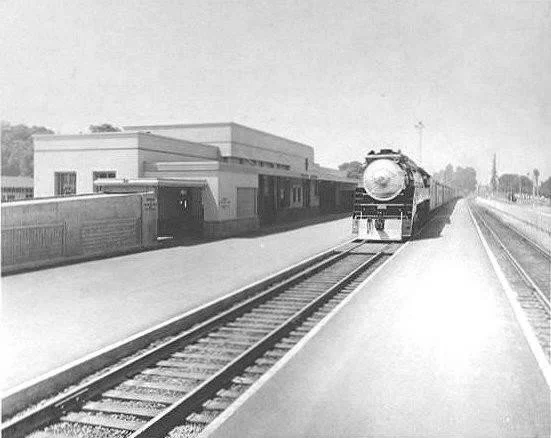
Southern Pacific Daylight Limited at Palo Alto Station, 1942. Source: Caltrain
Sometimes good ideas last forever. And Boxing Day is an appropriate day to appreciate them. Local historian April Halberstat gives us an affectionate review of our epic, historic local rail line--now called Caltrain. An Opp Now exclusive.
San Jose has an extremely historic railroad running through our Downtown, hidden in plain sight. It has served us well for over 161 years. We can take enormous pride in its significance.
It is the San Francisco-San Jose Railroad (SF & SJ RR), conceived and planned in 1850. Today we call it Caltrain. It is the oldest complete segment of transportation infrastructure in America still in operation. We got our money’s worth.
Early San Jose knew that transportation was critical to their economy. The little Pueblo was founded to provide food to the Presidio in San Francisco. Produce was regularly transported to San Francisco via the Embarcadero at Alviso. Reliable tides and the prevailing westerlies in the afternoon were the motive power; the Bay was the transport corridor. It was a good system but not ideal.
A Railroad was the first major project planned after California statehood. Congress declared statehood in September of 1850 and San Jose’s industrious Legislature of a Thousand Drinks quickly got to work. In the cold and very wet January of 1851, Judge Davis Divine called a mass meeting in downtown San Jose. He promoted his idea of a rail line between San Jose and San Francisco.
Divine managed to raise $100,00 from the enthusiastic drinkers almost immediately. He spoke with representatives of Eastern financiers such as the Vanderbilts and the Rothschilds. There were reports that local banker William Ralston of San Francisco, who represented the Vanderbilts, was impressed. Steam railroads were already a mature technology in Pennsylvania and Baltimore. A railroad for San Jose was a “no-brainer”. Enthusiasm was high.
By September Judge Divine had incorporated the Pacific & Atlantic Railroad with Divine as president. His Board hired construction engineer William J. Lewis to survey the route and make a cost estimate. Lewis had a plan ready by December, just four months. Total cost of construction including rail lines, buildings and rolling stock was estimated at $1,539,126.17. Lewis’ drawing of the route is a work of art and one of the earliest maps of the Peninsula.
Just as Judge Divine was preparing to break ground, a financial panic swept America and construction was delayed. The project was delayed again as the group sought alternative financing. They managed to negotiate bond funding from the three California counties served by their rail line. The total amount raised was $900,000.
The project was reorganized four times as the business climate and financing changed, but groundbreaking finally took place in San Francisco in May of 1861. It was worth the delay; there would be a handsome return on investment for the three Counties.
Beginning construction of the rail line in San Francisco was a stroke of genius. As sections of the rail line became operational, freight revenues began generating income.
It was a pay-as-you-go operation. Essential commodities such as oysters and fresh milk from South San Francisco farms began arriving to feed hungry San Francisco residents within a matter of months. Beef and pork as well as flour, fruit and vegetables from San Mateo farms were making the trip to San Francisco restaurants every day. The railroad began making money for its investors almost immediately.
By October of 1863 the SF & SJ Railroad was operating with three engines on a schedule of two trains a day. The War of the Great Rebellion was underway in the East. California, however remained calm. The morning train left San Francisco at 8:30 a.m. daily for stations south, delivering mail and other necessities to stations in San Mateo County. The return trips brought fresh food and fodder to San Francisco.
The trackage finally reached San Jose in January of 1864. The San Francisco & San Jose Railroad was completed in two years and seven months. The entire town, and most of Santa Clara County turned out to greet the three locomotives and twenty-nine rail cars with a band and a tremendous BBQ picnic. This rail line was completed five years before the Golden Spike was driven, completing the transcontinental railroad. Travel time between San Jose and San Francisco was now two hours and ten minutes. One-way fare was $3.00.
The value of this critical transportation corridor has been obvious from its beginnings. A bipartisan effort by the California legislature acquired this important rail line from Union Pacific to serve local commuters. Caltrain was founded in 1985 when State Senator Becky Morgan led an effort to acquire the railroad, San Jose’s most important transportation corridor. The line has been upgraded and is now completely electrified as of February of 2025.
The original twenty-five stops added six more as the line stretched to Gilroy. The line features six historic depots; five on the National Register of Historic Sites. The oldest depot west of the Mississippi is Santa Clara, operational as a depot until recently. Today the line itself deserves recognition as our national treasure.
April Halberstadt, Historian
Source: Clyde Arbuckle, History of San Jose
Follow Opportunity Now on Twitter @svopportunity
We prize letters from our thoughtful readers. Typed on a Smith Corona. Written in longhand on fine stationery. Scribbled on a napkin. Hey, even composed on email. Feel free to send your comments to us at opportunitynowsv@gmail.com or (snail mail) 1590 Calaveras Ave., SJ, CA 95126. Remember to be thoughtful and polite. We will post letters on an irregular basis on the main Opp Now site.