
☆ Government databases are the problem, not Flock cameras
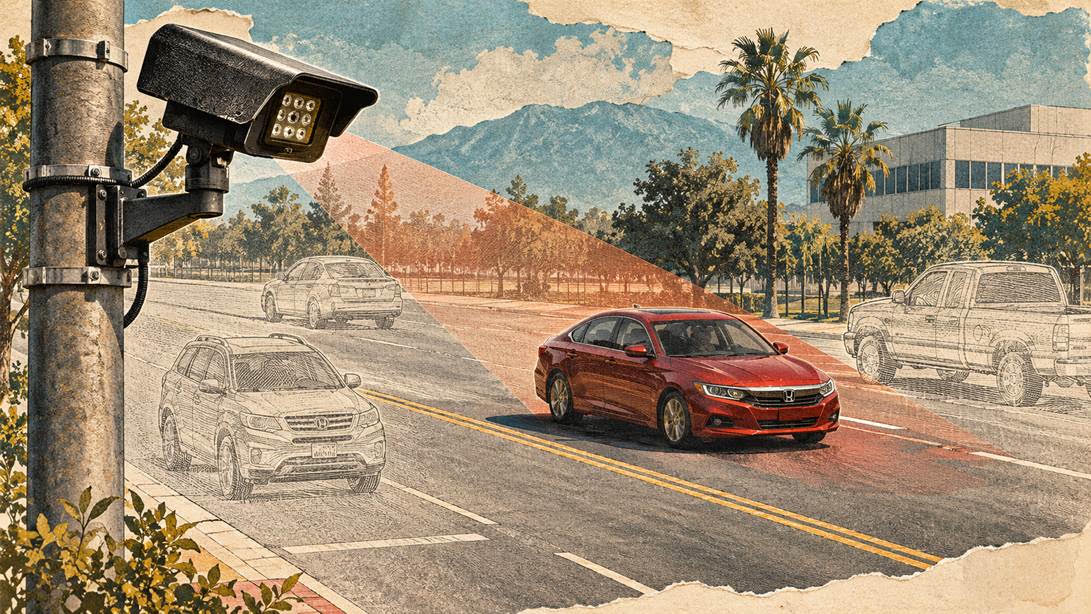
“Finding the needle doesn't require government to build a searchable haystack out of everybody else's daily lives,” says Liberty Lens podcast host Mike ter Maat in an Opportunity Now exclusive article on the Flock camera controversy: “Find the vehicles government is lawfully seeking. For everyone else, don't collect the data.”
Automated license-plate readers have handed local officials a genuine conundrum. Police departments have a legitimate interest in using technology to find stolen cars, locate missing children, and identify vehicles connected to crimes. Residents have an equally legitimate interest in not having government quietly assemble a searchable history of where they drive.
Municipal officials are being asked to do both: use available technology to make law enforcement more effective and protect the privacy of the same citizens whose safety they are charged with protecting. Simply choosing one objective over the other isn't much of a solution.
As a former police officer, I have no objection to running license plates. Officers have done it for decades. I did it routinely.
But when I ran a tag, I was trying to determine whether that particular vehicle was stolen, wanted, or otherwise of legitimate interest to law enforcement. I was not simultaneously creating a government record that Mike ter Maat's Honda was at the corner of Main and First at 3:17 Tuesday afternoon, available for some entirely different investigation six months later.
That is what has changed. Not merely the number of observations, but government's technological ability to collect, retain, aggregate, search, and reconstruct them.
There are now well over 100,000 automated license-plate readers operating across the United States. They aren't going away, and the political debate has largely moved beyond whether the cameras should exist. The fight is increasingly about what government should be permitted to do with the information they produce.
But even that question starts too late.
Before arguing about how long government may retain the data, who may search it, or what conclusions sufficiently sophisticated technology can draw from it, we should ask a more fundamental question: Should government be permitted to create identifiable records of innocent motorists' movements in the first place?
The sought-vehicle rule
I propose a simple rule: every automated plate observation should produce one of two results—YES or NO.
YES means the plate matches a vehicle already on an authorized sought list: a stolen car, an Amber Alert, or a vehicle legitimately connected to a crime or investigation. Only then may the system create an identifiable government record. Rules concerning access, retention, warrants, sharing and evidentiary use would still apply.
NO means the vehicle is not being sought. In that case, no identifiable record gets created. No stored plate number, photograph, location, timestamp, vehicle description or other information capable of reconstructing the observation later. The computer checks the plate, finds no match, and forgets it.
This is deliberately more protective than shortening retention periods. Seven days of government tracking is better than thirty. But it is still seven days of innocent people's movements sitting in a government database.
The principle is straightforward: suspicion should precede surveillance, not result from it.
Technology can help police find the proverbial needle dramatically faster. Good. Nothing about liberty requires police departments to pretend computers haven't been invented.
But finding the needle doesn't require government to build a searchable haystack out of everybody else's daily lives.
The constitution shouldn't depend on how good the cameras are
Courts have increasingly approached these cases by asking what the technology can actually accomplish. How comprehensive is the camera network? How long is the data retained? Can the system reconstruct someone's movements with enough accuracy and persistence to implicate the Fourth Amendment?
That approach is understandable under existing precedent. As a long-term constitutional principle, however, it produces a peculiar result. The implication is that surveillance technology is constitutionally comfortable when it works, but not too well.
A system may pass constitutional muster today because it captures only fragments of your movements. Add cameras, improve software, connect jurisdictions and increase the ability to reconstruct your life, and eventually the constitutional answer may change.
That means the boundary protecting individual liberty moves according to camera density, storage capacity and technological sophistication. Those are strange variables on which to hang a constitutional right.
The better question comes earlier. Not what can government do with the database? But why should government have a database of innocent people's movements at all?
The Sought-Vehicle Rule answers that question by focusing on governmental purpose rather than technological capability. Government may use the technology aggressively to find a vehicle it already has a lawful reason to seek. Everyone else's identifiable information never becomes government data.
There is a cost
This proposal is not free of tradeoffs.
Police would lose some retrospective investigative capability. A vehicle that is entirely uninteresting today may become important to an investigation tomorrow. Under the Sought-Vehicle Rule, yesterday's observations would no longer be available. Sometimes that will make solving a crime harder.
The definition of the “sought list” also matters enormously. A narrow privacy rule becomes rather pointless if government can casually place thousands of vehicles on the list. False matches, stolen plates and technical errors require safeguards, and meaningful auditing would be necessary to ensure that information supposedly discarded really is discarded.
Nor does this solve every question involving privately owned cameras or privately collected data later obtained by government.
Those are real limitations. But constitutional limits generally have costs. The point of a limit on government power is not that exercising more power would never be useful.
We don't need to choose between useful technology and privacy. We need to decide when government gets to create the record.
Find the vehicles government is lawfully seeking. For everyone else, don't collect the data.
That gives police a powerful tool without asking Americans to trust every future police chief, prosecutor, contractor or politician with a searchable history of their movements.
Constitutional government was never supposed to depend on that much trust.
Follow Opportunity Now on X @svopportunity
We prize letters from our thoughtful readers. Typed on a Smith Corona. Written in longhand on fine stationery. Scribbled on a napkin. Hey, even composed on email. Feel free to send your comments to us at opportunitynowsv@gmail.com or (snail mail) 1590 Calaveras Ave., SJ, CA 95126. Remember to be thoughtful and polite. We will post letters on an irregular basis on the main Opp Now site.