
☆ Fact check: media’s 4 biggest deceptions about the transit tax
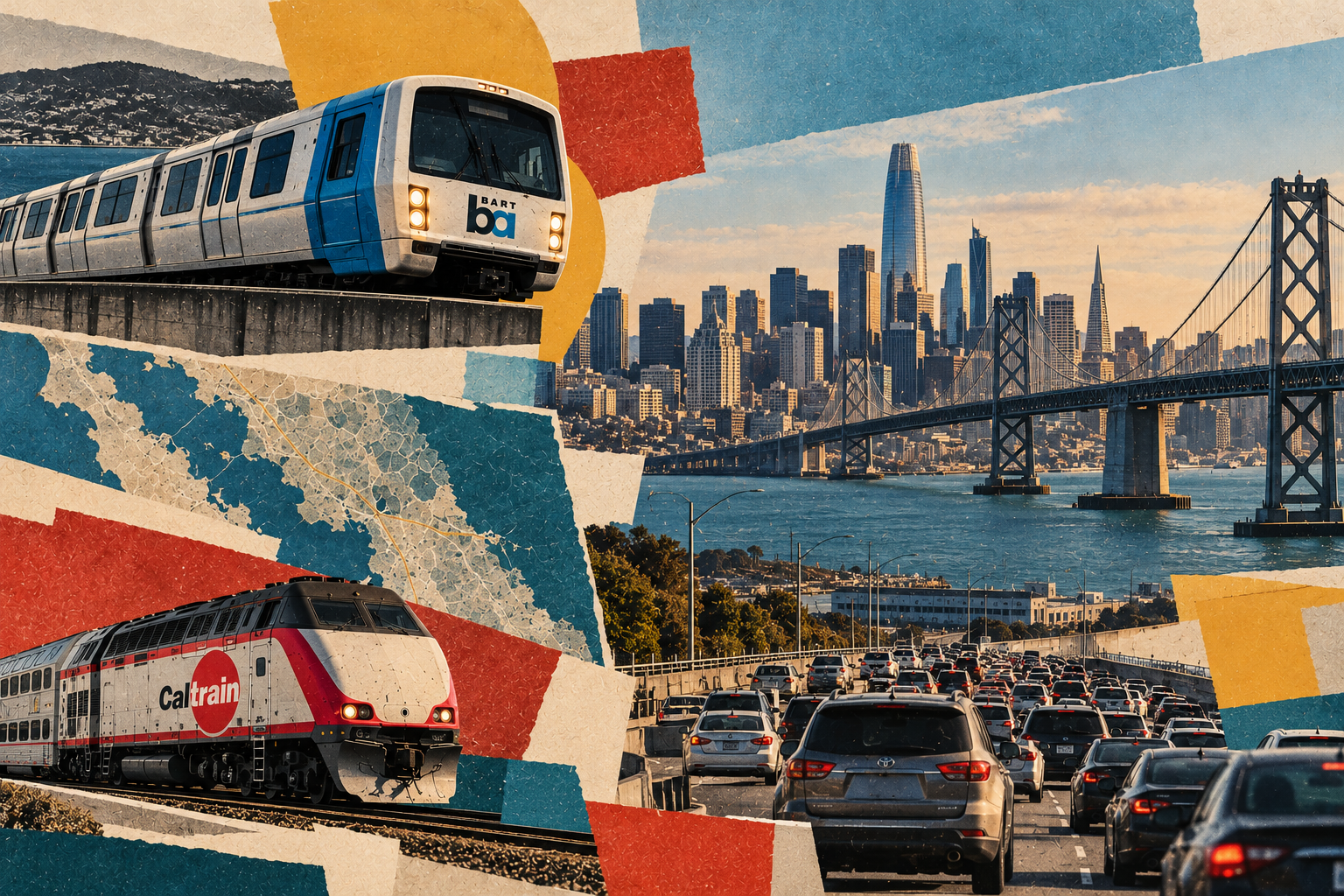
Leaning on SPUR’s contentious “Bumper to Bumper” report, The East Bay Times (aka Merc) again goes big with the scare tactics. But how much of this projected catastrophe is grounded in reality? In an Opp Now exclusive, transit expert Tom Rubin fact checks four of the most dubious assumptions behind SPUR's predictions.
East Bay Times claim #1: If voters don’t approve a new tax, BART and Caltrain will close stations
East Bay Times: “The [SPUR] analysis focused on key highway bottlenecks and assumed that BART and Caltrain would close stations with the lowest ridership. Neither agency has determined which stations would close.”
Fact Check: Misleading. The cuts are not inevitable.
Tom Rubin: Are they really going to make these cuts? I don't think so.
Look, I have been the CFO of two of the largest transit agencies in the U.S. Every single year, you have budget cuts you need to make, even in a good year. You never have enough money to operate everything you'd like to. You always have to cut, and in a bad year, it gets really ugly.
The first thing I would look at is what other money can we find. We believe that there is a lot of money that can be shifted over without a whole lot of trouble.
Is there a way to transfer money so that it is not necessary to make cuts?
Can we get more money? Yes. Can we cut costs? We believe they can.
This has been coming for years. Everybody could see it was coming for years, and why didn't they start doing things years ago? Because they thought they could bluff and get more money.
East Bay Times claim #2: Commute times will skyrocket
East Bay Times: “According to the study, peak-hour traffic delays on the Bay Bridge could increase by 33 minutes heading west in the morning and 43 minutes heading east in the evening. Eastbound afternoon delays at the Caldecott Tunnel could increase by 27 minutes, from 13 minutes to 40 minutes. The analysis also projects worsening congestion along Interstate 580, Interstate 680 and U.S. 101.”
Fact Check: Misleading. The projections ignore how commuters and employers adapt.
Tom Rubin: The reason I don't agree with these commute time predictions is that SPUR is refusing to acknowledge that people and businesses will make changes if you give them any warning at all.
When a major transportation system component goes completely out of service with no notice whatsoever, then yes, you're going to have problems. But when it is announced well in advance that you're going to make a reduction in service, the impact is not as large, and people have time to adjust.
So, what adjustments will be made? How about remote work? We saw this explode during COVID.
What else can you do? Vanpool and rideshare and club buses. Many employers have their own transit systems, like the Silicon Valley buses right now that take people from San Francisco to Silicon Valley. There are a lot of charter companies out there that would love to get that business.
SPUR is describing an absolute worst-case scenario that assumes that no actions are taken by the private parties, let alone by the agencies themselves, to adjust their service.
East Bay Times claim #3: Transit cuts hurt low-income riders the most
East Bay Times: “‘The burden of transit cuts would fall hardest on people who cannot simply switch to driving, including low-income workers, students, older adults, and people with disabilities,’ according to the study. ‘But the consequences would ultimately be shared by everyone.’”
Fact Check: Misleading. Higher-income riders are among transit's biggest users, and there are cheaper ways to protect vulnerable riders.
Tom Rubin: The people who don't use transit are in the middle of the income range. Generally, you break demographics into five quintiles, and the quintiles that use transit the most are the highest and the lowest.
And so that means that the high-income people use BART, they use Caltrain, and they use the ferry services, and these are all very expensive.
Will it hurt low-income people? Of course, particularly those that actually are transit dependent. But there are better ways to mitigate the harm to the transit dependent.
Claim #4: Transit agencies have no choice but drastic service cuts
East Bay Times: “Bay Area transit agencies have contingency plans for service cuts if they cannot secure additional funding for 2027 and beyond.
Under those plans, BART could close up to 15 stations and end service at 9 p.m. each night. AC Transit would seek to preserve coverage for low-income areas, but even then the agency would lay off more than 200 workers and cut hours. Caltrain could close more than one-third of its stations.
The study primarily examined BART, Caltrain and Muni because AC Transit had not adopted its contingency plan when the analysis was conducted. It did not model a complete BART shutdown.”
Fact Check: Misleading. Contingency plans aren't inevitable outcomes.
Tom Rubin: If you have to do a cut, the emphasis should be doing the greatest good for the greatest number, to operate the service that people need the most, and that's most cost effective. I'm not sure that what I see in the transit agencies’ plans is anywhere near that.
It’s time to start sitting down with their unions and say, ‘You guys have got to contribute.’
And until the crisis is over, management is not going to get a raise. I did that myself, I didn't have a raise for two years. I didn't like it, but it’s the least we could do.
They should also change work rules so that pay doesn't go down, but more work gets done.
This needs to be done immediately. Will it take a while to implement? Yes. But this is supposed to be a 14-year deal. So even if we don't get one dollar the first year, improvements will take effect more and more as time goes on.
We need to stop spending millions and tens of millions of dollars a year in planning and designing rail systems that are going nowhere.
For example, we have Link 21, which originally was going to have rail to not only the nine Bay Area counties, but 21 counties, all the way to Sacramento and into the Central Valley, etc. Can we put this to bed? Can we just close it up? Stop paying the employees. Stop paying the consultants. That's it. We don't need it anymore. Same thing with BART to San Jose. Can we just stop paying for that? The Portal project, etc. Can we just stop on these already?
Follow Opportunity Now on Twitter @svopportunity
We prize letters from our thoughtful readers. Typed on a Smith Corona. Written in longhand on fine stationery. Scribbled on a napkin. Hey, even composed on email. Feel free to send your comments to us at opportunitynowsv@gmail.com or (snail mail) 1590 Calaveras Ave., SJ, CA 95126. Remember to be thoughtful and polite. We will post letters on an irregular basis on the main Opp Now site.